
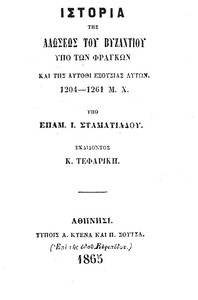
Ιστορία της Αλώσεως του Βυζαντίου υπό των Φράγκων και της αυτόθι εξουσίας αυτών
Let's set the scene: it's 1204. The Byzantine Empire, centered in the magnificent city of Constantinople, is the last remnant of the Roman Empire. It's wealthy, cultured, and a key power. Enter the Fourth Crusade, a massive army of European knights and soldiers who've taken vows to reclaim Jerusalem from Muslim control. But they need money and ships. What follows is a chain of deals, debts, and promises that leads them not to the Holy Land, but to the gates of Christian Constantinople.
The Story
Stamatiades lays out a classic tragedy of errors and ambition. The Crusaders get tangled up with a deposed Byzantine prince, Alexios Angelos, who promises them a fortune and military support if they help him reclaim the throne. They do. But once he's in power, he can't pay up. Resentment builds. Meanwhile, inside the city, political factions are at each other's throats. The stage is set for disaster. When the new emperor is overthrown, the Crusaders decide to take payment directly. They breach the legendary walls and unleash a three-day sack on the greatest city in Christendom. Stamatiades then follows the aftermath—how the victors carved up the empire, setting up their own 'Latin' kingdoms on Greek soil, a rule marked by tension and conflict that lasted for decades.
Why You Should Read It
This isn't a distant, neutral account. You can feel Stamatiades's passion. Written in the 19th century, a time of Greek national awakening, the book pulses with a sense of injustice and a warning from history. He makes you see the siege not just as a military event, but as a colossal failure of leadership and diplomacy on all sides. The Byzantine elites come off as dangerously divided, more focused on palace intrigue than the army at their gate. The Crusaders are portrayed as increasingly desperate and then brutally opportunistic. It’s a gripping study of how idealism (the Crusade) can be completely warped by practical needs (money, power) and personal vendettas.
Final Verdict
This is a must-read for anyone fascinated by the Crusades, Byzantine history, or the messy realities of how power works. It's perfect for readers who enjoy narrative history that has a clear point of view. Because it's from a specific Greek perspective, it offers a powerful counterpoint to many Western histories of the period. Be prepared for a story where there are few outright heroes, just flawed people making catastrophic decisions. If you want to understand one of the pivotal fractures between Eastern and Western Christianity, and a disaster that reshaped the medieval world, start here.
The copyright for this book has expired, making it public property. You do not need permission to reproduce this work.
Michael Nguyen
1 year agoRecommended.
Elizabeth Gonzalez
1 month agoAfter hearing about this author multiple times, the content flows smoothly from one chapter to the next. Don't hesitate to start reading.








Emma Sanchez
1 month agoIf you enjoy this genre, the plot twists are genuinely surprising. Exceeded all my expectations.