
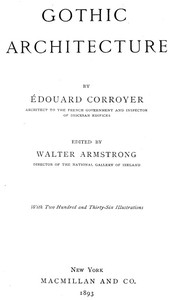
Gothic Architecture by Édouard Corroyer
Édouard Corroyer's Gothic Architecture is less a dry textbook and more a master builder's field notes brought to life. Originally published in the late 19th century, it comes from a time when people were just beginning to systematically study and appreciate these medieval wonders, not just as old churches, but as revolutionary feats of engineering.
The Story
The book doesn't have a plot in the traditional sense, but its narrative is the thrilling rise of the Gothic style itself. Corroyer walks you through its birth in the region around Paris, showing how builders moved away from the dark, heavy Romanesque style. He breaks down the key inventions—the pointed arch, the ribbed vault, and the famous flying buttress—and explains, with clear diagrams and passion, how they worked together. This new system was like a skeletal frame; it allowed walls to be filled with massive stained-glass windows, flooding interiors with colored light. The book follows this architectural revolution as it sweeps across Europe, evolving in England, Germany, and beyond, leaving a skyline of spires and cathedrals in its wake.
Why You Should Read It
What makes this book special is Corroyer's voice. He wasn't a distant academic; he was an architect and a historic monuments inspector. You can feel his boots on the stone floors. His explanations are grounded and practical. When he describes how a flying buttress channels weight, you can almost see the forces at play. He makes you appreciate that these cathedrals were the cutting-edge tech of their day, built by problem-solvers who combined faith with sheer cleverness. Reading it transforms how you look at these buildings. You stop seeing just a pretty church and start seeing a bold statement of "Look what we can do."
Final Verdict
This is the perfect book for anyone who's ever traveled to a historic city, looked up, and felt a sense of awe. It's for the curious traveler, the amateur history fan, or the person who enjoys understanding how things are built. While it's over a century old, its foundational explanations remain rock-solid. It might not have the full-color photos of a modern coffee table book, but its detailed illustrations and enthusiastic, firsthand insight offer something even better: the feeling of having a knowledgeable expert right beside you, pointing out the genius in the stonework. A classic guide for the eternally curious.
There are no legal restrictions on this material. Access is open to everyone around the world.
Emma Johnson
1 year agoUsed this for my thesis, incredibly useful.
James Flores
1 year agoGreat read!


Linda Thompson
1 year agoTo be perfectly clear, the author's voice is distinct and makes complex topics easy to digest. Exactly what I needed.